Mount Tai :Red Gate Tour Line
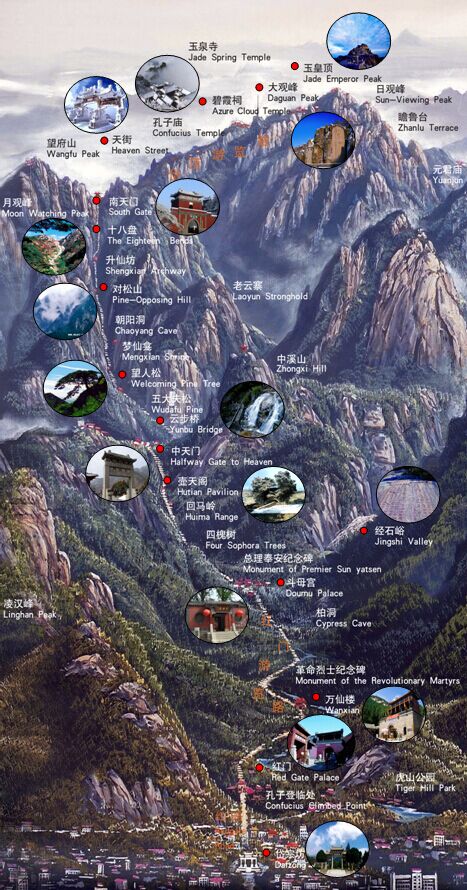
The Hongmen Tour Line is the main mountain tourism route throughout history, serving as the imperial route for emperors throughout history. Along the way, shaded paths line the streets, stone steps spiral, peaks are beautiful, springs and streams compete, and the natural scenery is majestic and beautiful. There are numerous historical sites, including 8 ancient temples, over 200 steles, and more than 300 cliff inscriptions, rich in traditional cultural charm. In ancient times, emperors, ministers, literati, and commoners often began climbing Mount Tai from the central route, which is why the central route is known as the "Ascending to Heaven Scenic Area." Because this road is deep and secluded, it is also known as the "secluded area" of Mount Tai.
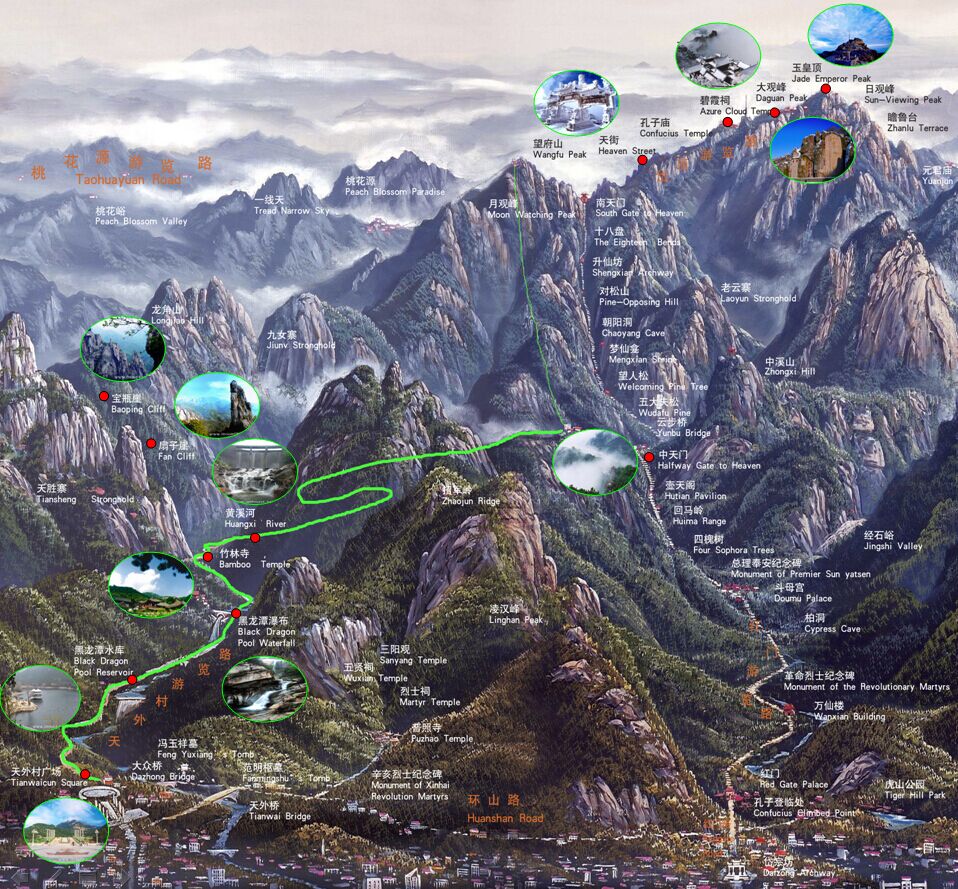
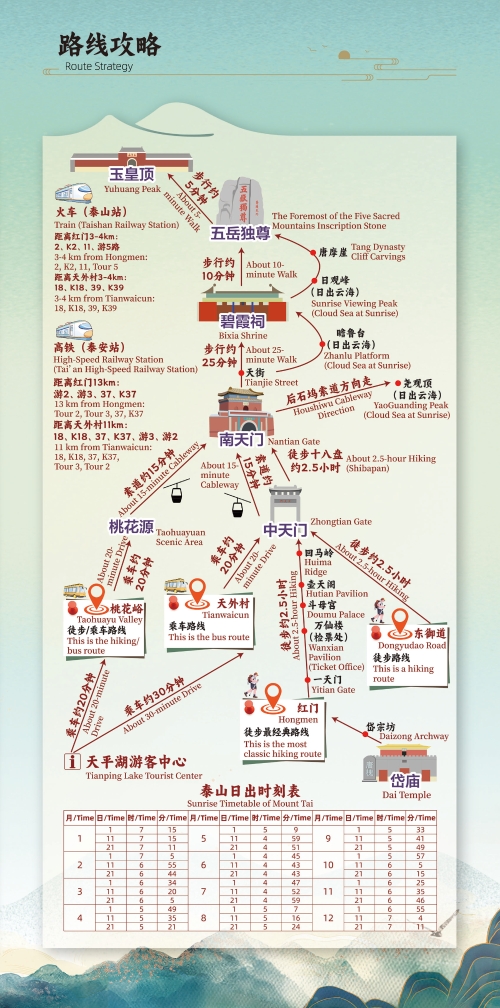
Attractions along the way include Daizong Archway, Guandi Temple, One Heaven Gate, Confucius' Visit, Red Gate Palace, Wanxian Tower, Revolutionary Martyrs Monument, Boundless Wind and Moon Stone Carving, Sanguan Temple, Doumu Palace, Yuanjun Temple, Jingshiyu, Feng'an Memorial Stele, Huimaling, Zhongtianmen, Yunbu Bridge, Wudafu Pine, Wangren Pine, Chaoyang Cave, Shibapan, Shengxian Archway, South Heavenly Gate, and more.
Guan Di Temple
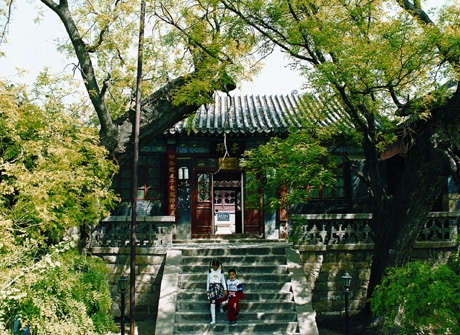
The Guandi Temple at the starting point of the winding path of Mount Tai faces south, with its founding date unknown. The four large characters "Divine Mighty Great Town" on the screen wall in front of the temple gate were inscribed by Emperor Qianlong of the Qing Dynasty when he ascended Mount Tai.
The Guandi Temple is built along the mountain's natural contours, with an overall layout arranged in a staggered manner. The buildings are located within three courtyards, with main structures including the mountain gate, opera stage, worship pavilion, main hall, and auxiliary halls. Entering the mountain gate, the building above the gate is the opera stage, which was where merchants held celebrations.
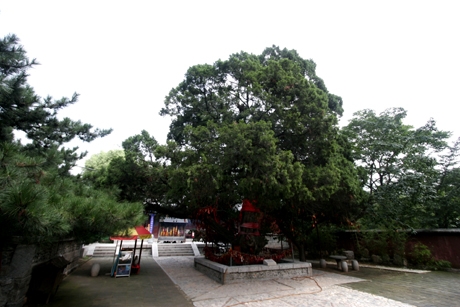
On both sides of the stone steps on the first-level platform of the Guan Di Temple, there are two ancient locust trees, their branches and leaves intertwined, resembling a dragon and a phoenix, inseparable and closely connected, known as the "Dragon and Phoenix Pagoda," said to have been planted in the Tang Dynasty.
Climbing the stone steps leads to the worship hall, which is ingeniously designed and serves multiple purposes in one hall: facing north for worshipping gods, facing south for watching operas, and benches are usually a great spot for tea tasting and rest. Directly behind the worship altar is the main hall, which houses a seated statue of Guan Gong. Guan Yu's given name was Guan Yu, courtesy name Yunchang, born in 160 AD, and died in 219 AD. Throughout nearly sixty years, Guan Yu rode his horse and wielded his sword, galloping across the battlefield, conquering many heroes, and assisting Liu Bei in achieving the great task of establishing the Three Kingdoms. He was later praised as a moral model embodying "loyalty," "trustworthiness," "righteousness," and "courage," honored as the "Martial Sage," and became a sacred idol widely worshipped by emperors and ministers in the late feudal period of China, as well as scholars, farmers, artisans, and merchants.
On the north side inside the East Mountain Gate, there is a dew well, also known as the "Spirit Well." Originally, the well water was used for temple Taoists and worshippers to drink, and it was named for its sweet water, resembling sweet dew. Next to the dew well stands a century-old trumpet creeper, a vine plant estimated to be nearly 200 years old. Now, its old trunk has withered, but new branches are vigorous. Every summer, trumpet creeper blooms in full bloom, its corolla bell-shaped, orange-yellow on the outside and bright red inside, dazzling and radiant. This tree is listed as a World Heritage Site.
Inside the Guan Di Temple, ancient trees flourish. Entering the backyard from the right side of the main hall, there is an ancient cypress with a peculiar shape. The main trunk and branches are twisted and grown, and at the trunk, three major branches branch off. The trunk is only 0.8 meters tall and 1.1 meters in diameter. Its three twisted branches twist and coil upward, forming a dense and twisted structure like a coiled dragon, giving a sense of elegance and elegance. This "Han Cypress No. 1" has been listed as a World Heritage Protected Site.
This temple is the first temple at the beginning of the winding path of Mount Tai. In terms of the overall layout of the Guandi Temple, the architectural design and site selection are truly ingenious.
The place where Confucius ascended and viewed it
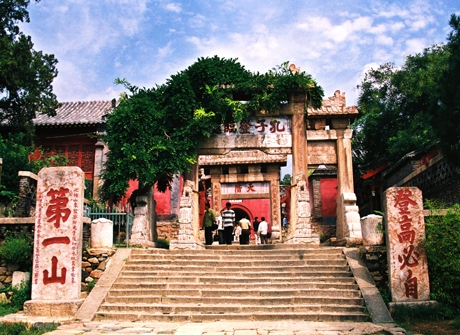
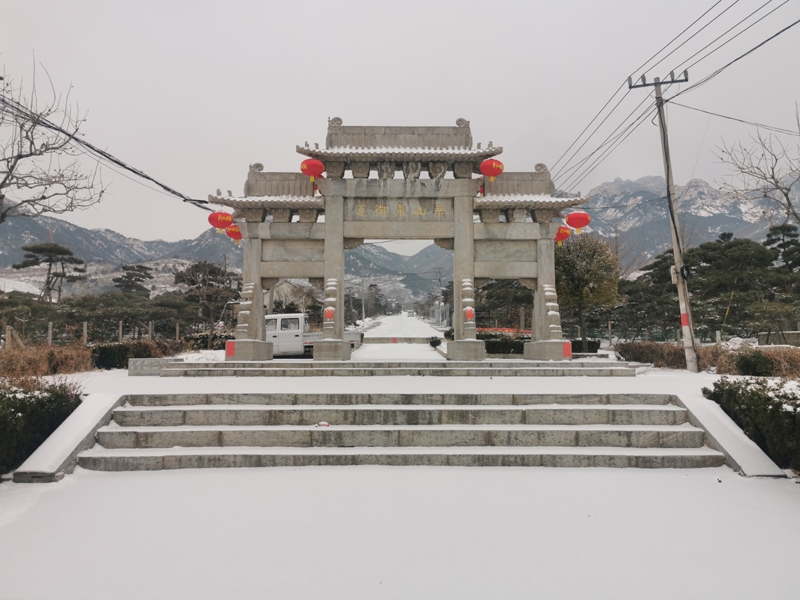
Located north of the Tiantianmen Gate, it is a stone archway spanning the road with four pillars and three gates. Shaded by ancient vines, elegant and dignified, the inscription above the gate reads "Confucius Ascended and Visited." It was first built in the 39th year of the Jiajing reign (1560). The couplet reads: "The Plain King walks alone through the ages, the sage ruler arrives from afar to celebrate ten thousand years." On both sides of the archway stand two steles: the eastern stele inscribed by Zhai Tao, the Tongzhi of Jinan Prefecture, during the Jiajing period of the Ming dynasty, inscribed "Climbing High Must Be From"; the west stele is the "First Mountain" stele inscribed by Li Fuchu, the Inspector of Shandong. The north side features the "Heavenly Steps" archway with two pillars and a single gate.
Red Gate Palace
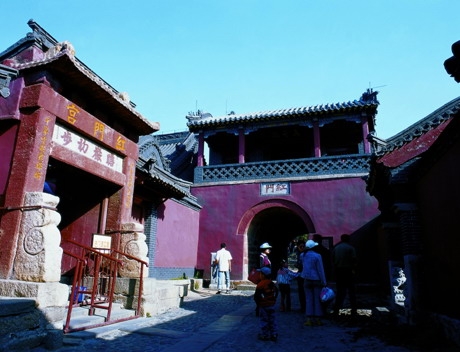
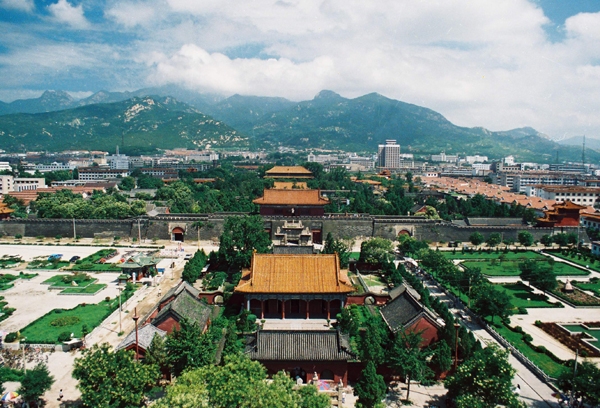
It is located north of the stone archway of the 'Confucius Ascending Site.' The place faces Zhongxi to the east and Dazang Ridge to the west, and is named for the red cliffs on the ridge resembling a gate. The founding of Hongmen Palace is unknown and was renovated in the sixth year of the Tianqi reign (1626). It is divided into east and west courtyards by a winding road, connected by the Feiyun Pavilion across the road, with the arched doorway inscribed with the two large characters "Red Gate." The west courtyard is a Taoist temple, with the palace gate inscribed 'Red Gate Palace' above the palace gate, dedicated to the goddess of Mount Tai, serving as the central temple of Bixia Yuanjun. The east courtyard is the 'Maitreya Courtyard,' dedicated to Maitreya Buddha.
passing through Shiyu
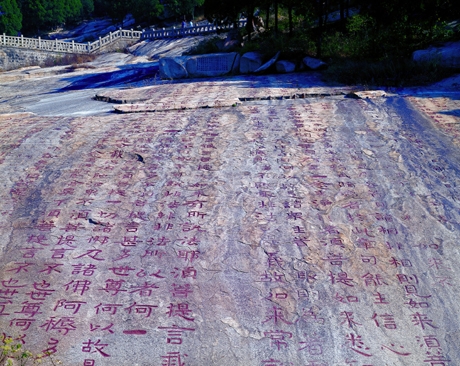
Jingshiyu is located northeast of Doumu Temple on Mount Tai, connected by winding paths and forked paths. Crossing Shuyu Bridge, Gaoshan Liushui Pavilion, and Shenling Bridge leads directly to the site. In the valley is a gently sloping stone terrace, inscribed with clerical script of the Diamond Sutra, commonly called the Sun-Drying Scripture Stone. During the Longqing period of the Ming Dynasty, Wan Gong inscribed the "Sun-Drying Scripture Stone."
The Jingshiyu Diamond Sutra Inscription is located northeast of Doumu Temple, Jingshiyu, and is the largest existing Buddhist scripture cliff inscription in China.
The scripture is carved on a gently sloping stone terrace covering 2,064 square meters, and from east to west, the Diamond Prajnaparamita Sutra is carved using the Later Qin Kumarajiva's translation. Originally, it consists of one volume, 32 sections, and 5,172 characters, but only the 15th section is carved with 'Special Merit and Merit,' totaling 44 lines, each line containing 125 or 10 characters, totaling 2,799 characters and each character measuring 50 centimeters. After more than a thousand years of weather, mountain flood impacts, trampling by visitors, and excessive rubbing, more than half of the scripture has been worn away. Only 41 lines and 1,069 characters of scripture remain (including legible broken characters and double outlines).
Zhongtian Gate
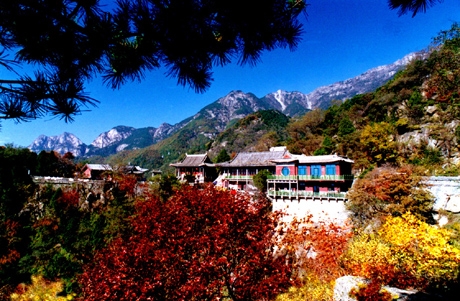
Zhongtianmen is the intersection of the eastern and western routes for climbing Mount Tai. This is the halfway to the summit, a necessary passage up and down. Zhongtian Gate was built during the Qing dynasty and is a stone archway with two pillars and a single gate. In ancient times, Mount Tai was home to many tigers. The ancients built a temple north of the archway to worship the Black Tiger God. Today, inside the temple, the God of Wealth, Marshal Zhao Gong, holds a whip and rides a tiger. To the east is an ancient-style teahouse, to the southwest is Zhongxi Hotel, and to the northwest is Zhongtianmen Cableway Station. Zhongtianmen is located on the ridge of Huangxian Ridge, at an elevation of 847 meters. Huangxian Ridge is named for its yellow-red soil. To the east of Huangxian Ridge is Zhongxi Mountain. In 1989, Taiwanese compatriot Chen Yingjie donated funds to build the Ci'en Pavilion at the summit. Inside the pavilion are Penghu stones donated by Penghu compatriots, inscribed with inscriptions, expressing the hope for the early unification of both sides of the Taiwan Strait.
On the north side of Zhongxi Mountain is Dongxi, commonly known as Dazhigou, which was formerly the eastern route of Dengdai but was later abandoned. Zhongtianmen is surrounded by towering ridges and wide valleys, surrounded by towers and pavilions. To the east stands Zhongxi Mountain, towering and beautiful, suitable for watching the sunrise and gazing at the evening glow; To the west lies Phoenix Ridge, winding and stretching, offering distant views of its majestic presence and a view of the city's new appearance. Standing beneath the archway, looking north toward the majestic Mount Tai, the mountains stand in arches, the forests lush and springs flying, the cable car soaring through the air, naturally forming a picturesque scene.
The Fifth Gentleman's Pine tree
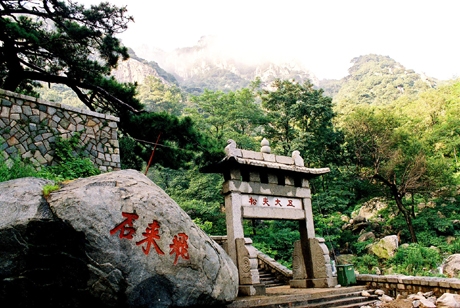
Located beside the Five Pine Pavilion north of Yunbu Bridge. At this point, the winding road stands a stone archway, inscribed with 'Wudafu Pine.' To the west of the arch stands an ancient pine, also called 'Qin Pine,' and 'Qin Pine stands tall and elegant,' one of the Eight Scenic Spots of Tai'an.
The Five Officials Pine, according to legend, was sheltered under a large tree during the rain when Qin Shi Huang ascended Mount Tai. Because the tree protected the emperor, he was granted the title "Five Ministers" by Qin Shi Huang. The Five Officials were the ninth official rank in the Qin era.
Since the Han and Tang dynasties, people generally believed that Qin Shi Huang granted five pine trees the title of Grand Master. In the eighth year of Yongzheng in the Qing Dynasty, Ding Zaobao, who was responsible for restoring Mount Tai, replanted five pine trees based on popular tradition, two of which remain today.
Looking toward the pines of the human people
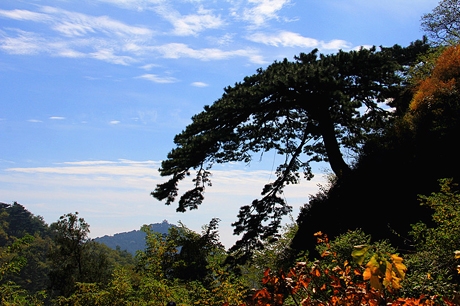
The Wangren Pine is one of the symbols of Mount Tai, standing proudly atop the cliff outside Wusong Pavilion. The pine stands 8 meters tall with a massive crown. A long branch hangs down, stretching toward the winding path, like a tender young girl, waving her arm to greet visitors and show welcome. Hence, it is also called the "Welcoming Guest Pine." Its crown resembles a canopy, with lush branches and leaves, seemingly ready to soar into the sky. Although it has endured more than five hundred years, it remains vibrant today and is considered a spectacular sight of Mount Tai.
Eighteen Bends
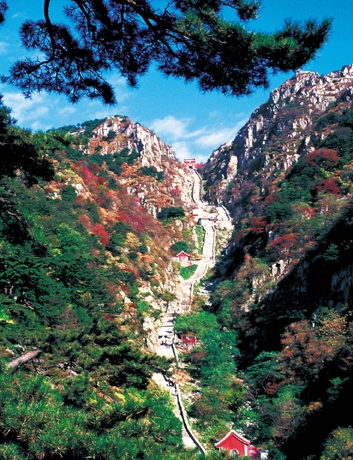
The Eighteen Benuses of Mount Tai are the most perilous sections of the mountain's climbing route and are one of the main landmarks of the mountain. Here, the two cliff faces are as if carved, with steep winding paths embedded within. From afar, they resemble the Heavenly Gate Cloud Ladder. The grandeur of Mount Tai lies in the Eighteen Bends, and the grandeur of Mount Tai is found in climbing it! The Eighteen Bends lie north of Duisong Mountain. On the high hill, twin cliffs flank the path. It was formerly called Yunmen, now called Kaishan, and was opened during the reconstruction of the winding road at the end of the Qianlong reign of the Qing Dynasty. The Eighteen Bends begin from here. The northern part of the mountain was opened to form Longmen; there was formerly a Longmen archway, but it was later destroyed. On the west cliff, during the Daoguang period of the Qing dynasty, Wei Xiang carved the large character 'Longmen' in wild cursive script. To the east of the archway site lies Dalongyu; during the rainy season, many waters flow into the gorge, and flying springs pour down like a torrent. In front is the new Pankou. During the Wanli period of the Ming Dynasty, Councillor Lü Kun built a crossing bridge across the stream and constructed a new winding road along the upper source of Longyu, directly reaching the southern gate of Bixia Shrine, making it very convenient for those ascending to and from Mount Tai. Both the bridge and the winding road were destroyed during the Qianlong period of the Qing Dynasty.
North of Xinpankou, two mountains rise steeply: to the east is Feilong Rock, to the west is Xiangfeng Ridge, and in the middle is a narrow sky, called Shibi Valley. Above the valley is the Southern Heavenly Gate, below is the Ascension Immortal Pavilion, connected by the Eighteen Bends. The South Heavenly Gate is located at the mouth of the valley and is a model of Mount Tai's ancient architecture that makes full use of the geographical environment to highlight and beautify the natural environment through human effort. It is one of Mount Tai's important landmarks. Looking up at the Heavenly Gate, the winding path is steep and sheer, like a cloud ladder hanging upside down. On both sides of Shibi Valley are inscriptions such as "Long Roar at Tianmen," "Layered Cliffs and Empty Valleys," "Tianmen Cloud Ladder," and "As if Ascending to the Horizon."
Taishan has three 'Eighteen Bends' theory. From Kaishan to Longmen is called "Slow Eighteen," then to Shengxian Ward is "Not Hurried, Not Slow Again, Eighteen," and then to South Heaven Gate is called "Tight Eighteen." On the western cliff of 'Jin Shiba', a huge rock hangs in midair, with a Buddha head resting on the side, a high nose and bald top, a kind face smiling, called the Welcoming Guest Buddha.
Ascension Workshop
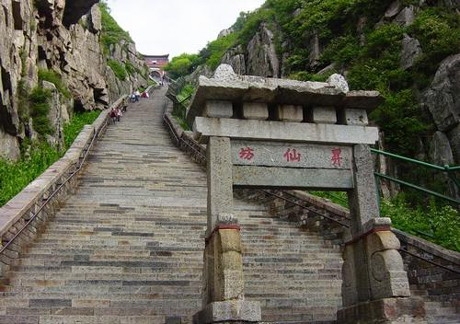
Shengxian Archway, constructed entirely of stone, with an unknown founding date. Heading north for 150 meters is the South Heavenly Gate, which has about 480 stone steps and is extremely steep. Its winding path is called the Eighteen Bends, and it is the most difficult part of climbing Mount Tai. Here, you feel as if you are ascending to the celestial realm of Mount Dai Heaven, as if you are ascending to immortality. The terrain here is steep, with sheer cliffs and sheer walls. Resting here and looking down at the foot of the mountain, one feels as if one is soaring into the clouds. Looking up, the Southern Heavenly Gate is right before your eyes; climbing with all your might, Mount Tai is in sight. Here, you may have realized the realization of self-realization in life, just like climbing Mount Tai—what you gain is a spiritual elevation.
On both sides of the winding path are inscriptions such as "Heavenly Gate Cloud Ladder," "Divine Blessings at Chongchao," "Harmony of Heaven and Earth," "Towering Pine and Towering Peak," "Flying Dragon Rock," "Soaring Phoenix Ridge," and "Knowing Where to Stop and Observe Stopping."
South Heavenly Gate
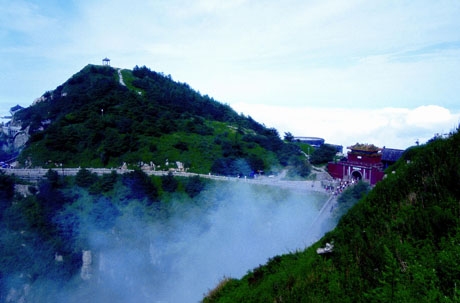
Nantianmen, also known as Santianmen, is located at the upper entrance of Shibi Valley, at an altitude of 1460 meters. Not only is it strategically strategic, but it also sits at the top of the central axis of the climbing trail, allowing visitors to admire its majestic image from the foot of the mountain. Whenever clouds and mist appear and change endlessly in the mountains, the Heavenly Gate appears and disappears amid the mist, with the eighteen winding paths hanging upside down like a heavenly ladder, making the main peak of Mount Tai even more majestic and magnificent. The South Heavenly Gate was established in the early Yuan Dynasty, funded by Zhang Zhichun, the abbot of Dai Temple. It is a city tower-style building with stone arched doorways, topped with a three-bay Mokong Pavilion, and a yellow glazed tile roof, with double-eaved hip-and-gable roofs. On both sides of the gate archway are couplets: "The gate opens to the ninth heaven, looking up to walk the wonders of the Three Heavens; The steps rise ten thousand tiers, overlooking the wondrous sights of a thousand peaks. "Visitors climb here and take in all the mountains at a glance, seeing the vast green sky, and their fatigue suddenly disappears. Li Bai once left an eternal quatrain here: "A long whistle at Heaven's Gate, a clear breeze sweeps in from ten thousand miles away." "Tianmen stands majestically atop the main peak of Mount Tai, with twin peaks standing side by side, as if the Heavenly Gate itself opens," the mountain forms a dome in perfect form, winding paths winding in thousands of layers like a soaring dragon. Looking back from among the clouds, I am startled by the road I came; on Mount Dai, I still recall the distant pavilion."
The architectural features of Nantianmen are a model of the clever integration of natural and cultural landscapes. Artificially harnessing the momentum of nature and relying on human strength, it is truly ingenious.
Recommended Popular


Quick Navigation
Related Recommendations