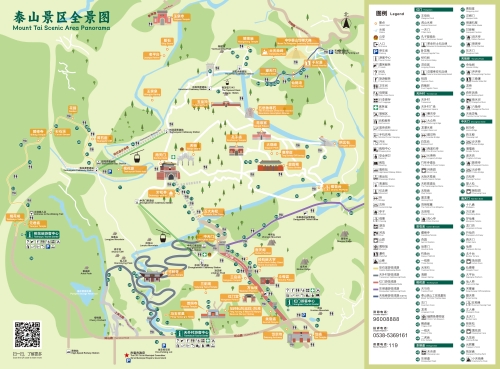
Mount Tai :Dai Temple (Scenic Spot Introduction)
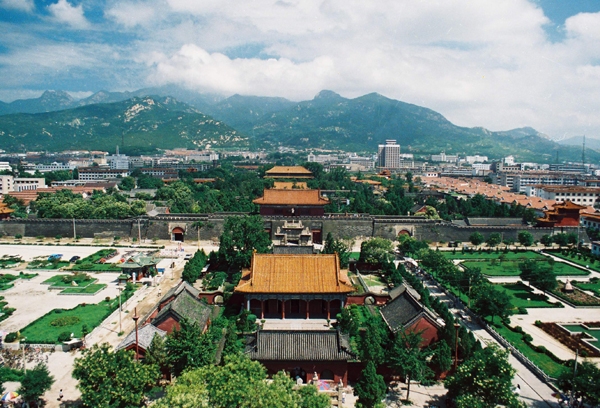
Dai Temple is located in the southern part of Mount Tai in the central part of Taicheng. It is also known as Dongyue Temple, Taiyue Temple, or Daiyue Temple, commonly referred to as Tai Temple. It was the main site for ancient Dai worship. Today, the temple contains 186 ancient and imitation buildings, 184 steles, 48 Han dynasty stone reliefs, 212 ancient juniper and Chinese juniper trees, and 292 species of ornamental plants. After the founding of the People's Republic, it served as the seat of the Taishan management office, and today it is the Tai'an City Museum. In 1988, it was listed as a National Key Cultural Relic Protection Unit.
Dai Temple, formerly known as the "Dongyue Temple" and also called Tai Temple, primarily worships the "Spirit of Dongyue Mount Tai." It was also the place where ancient emperors lived and held grand ceremonies during the Fengshan sacrifices at Mount Tai. Dai Temple has a long history of its founding. Western Han historical records first mention that "Qin established fields, Han also built palaces." In the thirteenth year of Kaiyuan of the Tang Dynasty (725 AD), it was expanded, and in the second year of Song Xiangfu (1009 AD), another large-scale expansion was carried out. According to the 'Inscription of the Renovation of the Taiyue Temple,' there were 'eight hundred and thirteen bays of halls, sleeping quarters, halls, closing, gates, pavilions, storehouses, halls, towers, pavilions, corridors, and side wings.' "Some buildings were destroyed during the Jin dynasty, but during the Yuan dynasty, they were further expanded. In the 26th year of the Ming Jiajing reign (1547), most of the temple's buildings were burned. In the Qing dynasty, it was restored, gradually forming a grand architectural complex. Dai Temple is located in the northern part of Tai'an City, right on the central axis of the South Gate of Old Taicheng in the south and the southern Heavenly Gate of Daiding in the north. It is 405.7 meters long from north to south and 236.7 meters wide from east to west, rectangular in shape, covering an area of 96,000 square meters. The architecture of Dai Temple adopts the ancient Chinese style of vertical and horizontal extensions, with the overall layout using north-south as the vertical axis, dividing it into east, central, and western axes. The east axis has Hanbai Courtyard, East Imperial Seat, and Garden at the front and rear of the east axis; Before and after the western axis are Tanghuai Courtyard, Huanyong Pavilion Courtyard, and Yuhuadao Courtyard; At the front and rear of the central axis are Zhengyang Gate, Peitian Gate, Ren'an Gate, Heavenly Gift Hall, Rear Sleeping Palace, and Houzai Gate. The main building, the Song Tiankuang Hall, is located in the rear half of the Dai Temple, perched high on a platform foundation, while other buildings are set outside the central courtyard, independent yet internally connected. This architectural layout was conceived and designed according to religious needs and the layout of the palace city, forming a distinctly divided style, orderly hierarchy, solemn, and simple style. Through spatial variations, it harmonizes solemnity, solemnity, depth, and elegance to create a complete whole. The majestic halls inside the temple echo the South Heavenly Gate soaring into the clouds, giving visitors a sense of being in the midst of Mount Tai. The city battlements of Dai Temple are built high, with a circumference of three huali and a height of three zhang. There are eight gates on all sides, five opening south: the Zhengyang Gate in the center, the East Side Gate on the left, and the Yanggao Gate on the left; To the right is the West Side Gate, and further to the right is the Main Gate; To the east is Qingyang Gate, also known as Donghua Gate; The westward one is called Sujingmen, also known as Xihuamen; To the north is called Luzhan Gate, also known as Houzai Gate. Each city gate has a city tower, and at the four corners of Dai Temple are the Xun, Gen, Qian, and Kanjiao towers. The entire structure is grand and imposing, resembling an imperial palace.
Dai Temple is the place with the highest concentration of Mount Tai cultural relics. Here, a dazzling array of ritual vessels, offerings, and crafts used by emperors to worship the Taishan deity is preserved, as well as unearthed artifacts from Taishan that shine with the brilliance of Chinese civilization and revolutionary historical relics, as well as a large number of Taishan classics and Taoist scriptures. Even more precious are 184 steles from various dynasties and 48 Han dynasty pictorial stones, making it the third stele forest in China after Xi'an and Qufu. Dai Temple is also a delightful classical garden. The ancient cypress trees with coiling dragons, ginkgo trees that block out the sky, exquisite bonsai, and competing flowers all add a thousand charms to the simple and elegant pavilions, terraces, towers, and pavilions. Dai Temple offers picturesque scenery all year round, attracting many domestic and international tourists. The solemn and majestic Dai Temple boasts magnificent halls and a collection of cultural relics. Every building here reflects the elegance of ancient Chinese architectural art, and every artifact reflects the development of Mount Tai's civilization. Strolling through this world of art, everything you see and touch is a national treasure, moving viewers and leaving visitors moved. The majestic Dai Temple is an ancient art museum that integrates architecture, gardens, sculpture, painting, and traditional Chinese culture.
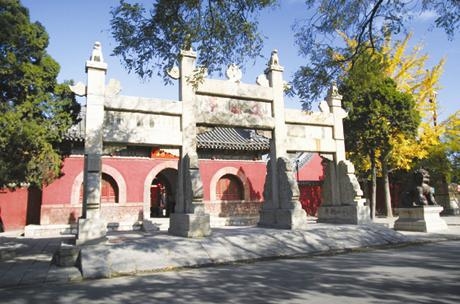
Yaoshen Pavilion: Also known as Caoshen Pavilion, it faces Tongtian Street in front and connects to the Zhengyang Gate of Dai Temple behind, serving as the front courtyard of Dai Temple. Emperors, princes, and ministers throughout history who came to Mount Tai for sacrificial ceremonies had to first perform a simple worship before entering the Dai Temple for the formal ceremony. In the Tang Dynasty, it was called the 'Remote Gate of Consultation'; During the Song Dynasty, a pavilion was built inside the gate, renamed 'Caoshen Pavilion'; During the Ming dynasty, it was expanded with the construction of hall walls and enshrined a statue of Bixia Yuanjun inside, thus becoming a complete courtyard building. The Yaoshen Pavilion is a vertical two-courtyard layout. The South Mountain Gate, Ceremonial Gate, Main Hall, Square Pavilion, and North Mountain Gate are located along the axis from Tongtian Street to Dai Temple. On either side of the main hall are side halls and side rooms, with the axis aligned with the central axis of Dai Temple. The main hall has five bays, built during the Ming Dynasty, with a yellow tile hip-and-gable roof and five beams. Inside the hall is a statue of Bixia Yuanjun. In front of the South Mountain gate is the Yao Can Archway, a four-pillar gate built in the 35th year of the Qianlong reign of the Qing Dynasty (1770). On either side of the stone arch stands a pair of Qing dynasty iron lions. Further south, beneath a giant Chinese locust tree, there is a pond where a dragon's head spits out water and another swallows water, inscribed with "Dragon Leaping in the Heavenly Pool," built in the sixth year of the Guangxu reign (1880) and adding to the scenery.
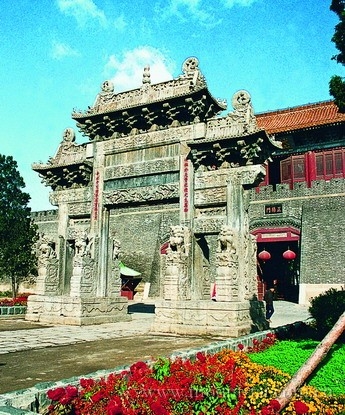
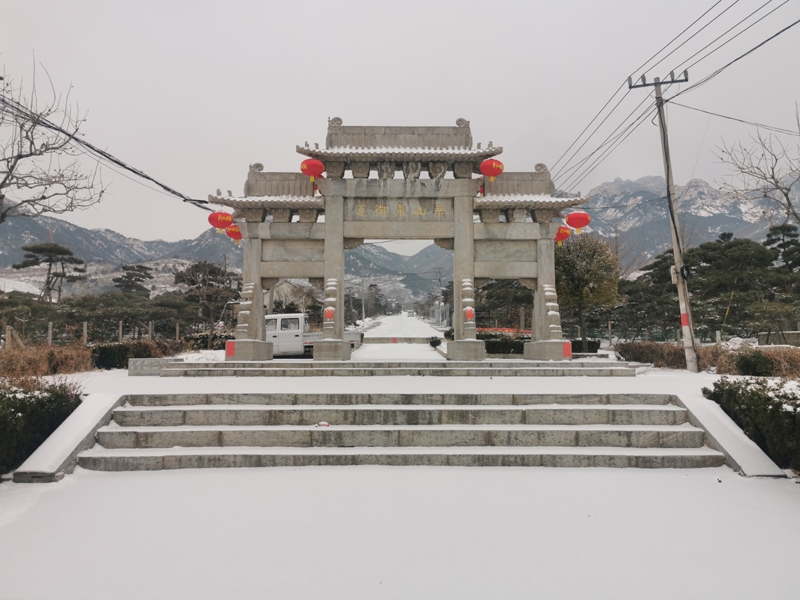
Daimiao Archway: Between Yaoshen Pavilion and Dai Temple is Dai Temple Archway, also known as Linglong Archway. Built in the 11th year of Kangxi during the Qing Dynasty, 1672 AD, it is a four-column, three-bay, three-story archway, with varying heights, full-length relief carvings, a grand design, and exquisite craftsmanship. It is a treasure of Qing dynasty stone carving architecture.
The arch roof is a Xieshan-style imitation wooden structure, with chiwen ornaments suspended in the air, layered dougong brackets, upturned eaves, and ridge beasts ready to leap. A precious vase stood upright in the center of the ridge, flanked by four great Vajra pulls for reinforcement. The small latrance of the central pillar is openly carved with two dragons playing with a pearl, and the dragon gate beam is carved with a red phoenix facing the sun. Below the archway is a cubic stone pedestal, each with two vertical pillars. Beneath the pillars are rolling stone pillars, on which are two pairs of crouching lions with standing sculptures: the male playing with embroidered balls, the female playing with young liones, each with a lively and charming pose. On the beams, columns, front panels, and rolling stone blocks, more than 30 lifelike auspicious beasts and auspicious birds are carved, including 'Rings in the Head', 'Dan Feng Facing the Sun', 'Two Dragons Playing with a Pearl', 'Cranes Playing with Lotus', 'Heavenly Horses Moving Across the Sky', 'Divine Ox Horn Fighting', and 'Qilin Delivering Treasures'. The pattern design employs symmetrical techniques, with highly varied composition and engraving techniques, possessing strong artistic appeal.
Both the inner pillars of the archway bear couplets on both the front and back sides. On the south side is a book written by Shi Tianyi, the founder and Governor of Shandong: "Towering to the highest heavens, praising the transformation and the primordial birth of all things; The emperor emerges from Zhen, his mighty voice cleanses the spirit, pacifying the eastern realm. "It means that the towering Mount Tai matches the sky, assisting heaven and earth in generating all things; The Mount Tai god who rules the universe, his mighty power intimidates the East. On the north side is Zhao Xiangxing, Governor of Shandong and Right Vice Minister of War, who inscribes a couplet along with the inscription: "As the unity of all mountains, all nations look up to its majestic virtue—how can virtue be praised; Harmonizing with the collective command of all spirits, the nine provinces await orders, vast and boundless—who can compare to the capital's achievements? The general idea is: Mount Tai is the ancestor of the Five Great Mountains, and people from all over the country come to admire its majestic grandeur. Who can surpass its virtuous and benevolent grace that brings forth all things? The god of Mount Tai controls the realm of gods and immortals, and all under heaven obey his command. His merit in protecting all living beings is vast and far-reaching—who can compare? The couplet insightfully summarizes the divine power of Mount Tai.
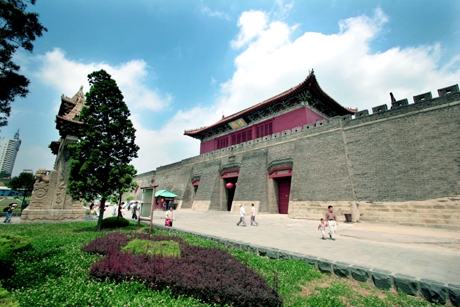
Zhengyangmen: Leaving Daimiao Archway, you see the tall and spacious "Zhengyangmen." Zhengyangmen was originally built in the Song Dynasty and destroyed in the mid-20th century. The current Zhengyangmen was rebuilt in 1985 in the style of Song Dynasty architecture. Entering Zhengyang Gate, there are two vermilion gates, each inlaid with 81 iron steamed bun nails and a shop head, symbolizing the dignity of Dai Temple. In ancient times, only emperors could enter through this gate. Zhengyangmen is 8.6 meters high, and the Wufeng Tower above is 11 meters high, with five bays in total. It features a nine-ridge, single-eaved hip-and-gable roof, covered with yellow glazed tiles, 24 square bright pillars, and three upturned four arches under the eaves, painted with large black lines dotted with gold. The golden dragons dance on the front beams, and from afar, the eaves look like wings, as if ready to take flight. On both sides of Zhengyang Gate were the East and West Side Gates.
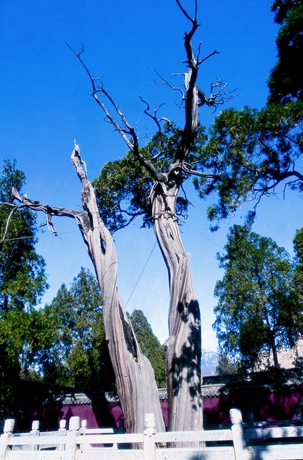
Han cypress: In the Han cypress courtyard of Dai Temple, there are five Han cypresses with unique shapes, twisted and towering like coiled coils, ancient and verdant. "Han Cypress Linghan" is one of the Eight Scenic Spots of Tai'an. According to the Han dynasty's "Records of Commanderies and States," it was planted when Emperor Wu of Han ascended Mount Tai to perform the Feng sacrifice. During Qianlong's southern tour, he painted the 'Han Cypress Painting' and composed the poem 'Inscription on Han Cypress,' which was engraved on stone.
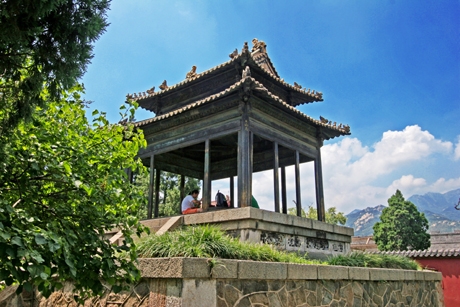
Bronze Pavilion: Also known as the 'Golden Palace,' it is located on the platform at the northeast corner of the temple. The pavilion is made of copper casting, imitating a wooden structure, with double-eaved hip-and-gable style. During the Wanli period of the Ming Dynasty, it was first built inside the Bixia Shrine on Mount Tai, known as the Golden Hall. In the 1970s, it was moved into the Dai Temple and is one of several famous bronze pavilions in China (Baoyun Pavilion in Beijing's Summer Palace, Golden Hall atop Tianzhu Peak on Wudang Mountain, and Golden Hall in Kunming). Two of Mount Tai's cultural wonders—the Qin Inscription Stele, also known as the Li Si Stele. This inscription was issued by Qin Er Shi Huhai in 209 BC by imperial edict and carved by Chancellor Li Si in small seal script. Small seal script has simple strokes and neat, elegant forms, and is more popular than the more complex large seal script. The 'Mount Tai Qin Inscription' was originally at Mount Tai, but gradually wore down over time. In the Qing Dynasty, it was moved to the Dai Temple at the foot of the mountain, but was once stolen and later recovered. The remaining seven characters are "I Qu Ji, I request now," and the half-damaged three characters are "Si Meishi." The 'Mount Tai Qin Inscription' has become a rare treasure.
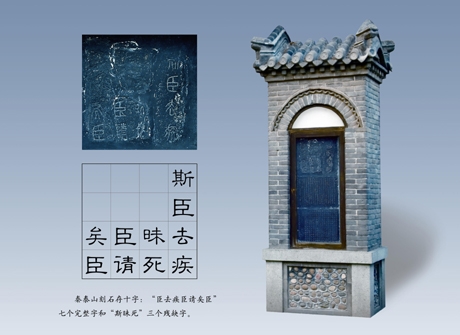
Qin Taishan Inscriptions: Located inside the eastern throne of Dai Temple, these are the earliest works among Taishan stone carvings. The inscription is the Merit Commemoration of Qin Shi Huang and the Second Emperor's Edict, inscribed by Prime Minister Li Si. The inscription stone was originally beside the Jade Maiden Pool on Mount Tai, but was later gradually moved here. The original inscription on the stone contains 222 characters, and after enduring many changes, only the seven characters "I have removed illness, I have requested to serve" remain intact, and the three characters "Si Meishi" are worn and worn out. The Qin Taishan inscription is listed as a national first-class cultural relic and is considered a rare treasure.
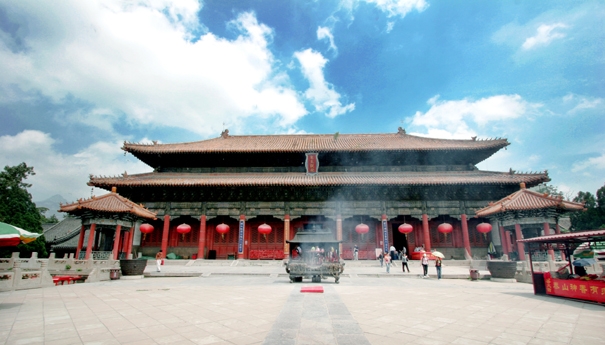
Song Dynasty Tiankuang Hall: The Tiankuang Hall is the main building of Dai Temple and serves as the palace of the Eastern Peak Emperor, the god of Mount Tai. Located in the middle and rear of the central axis of Dai Temple, it was first built during the Northern Song Dynasty. In the Yuan it was called Ren'an Hall, in the Ming it Junji Hall, and in the Republic of China era, it was renamed to its current name, originating from Emperor Zhenzong of Song's forgery of the 'Heavenly Book.' "Heavenly Gift" means 'bestowed by heaven.' Legend has it that on the sixth day of the sixth lunar month in the first year of Dazhong Xiangfu in the Northern Song Dynasty (1008), a 'Heavenly Book' descended upon Mount Tai. The following year, Emperor Zhenzong built the Heavenly Gift Hall on Mount Tai to thank Heaven. The entire main hall features carved beams and colorful rafters, gilded and painted walls, and vermilion walls standing tall, towering and majestic. Despite several dynasties, its ancient appearance remains.
The main hall is 9 bays wide and 5 bays deep, with a total height of 22.3 meters. It has a double-eaved hip roof covered with yellow glazed tiles. Between the double eaves stands a vertical plaque inscribed with "Song Tiankuang Hall." Under the eaves are densely set with dougong brackets, with large red eaves columns standing tall in front of the corridor, featuring doors and windows with three-cross and six-bowl diamond-shaped lattice panels. The main and secondary rooms have caisson ceilings with caisson ceilings and dougong brackets around them; the rest have square ceilings painted with golden ascending dragons. At the center of the hall is the god of Mount Tai, 4.4 meters tall, crowned with a crown and tassels, dressed in imperial robes and holding a tablet, looking like an emperor. Above the niche hangs a plaque inscribed by Emperor Kangxi of the Qing Dynasty inscribed "Matching Heaven to Suppress Protection," while opposite it hangs inside the main hall of the main hall hangs a plaque inscribed by Emperor Qianlong inscribed "Great Virtue Says: Birth." In front of the statue is a set of Qing dynasty bronze ritual vessels, as well as bronze jars and cauldrons. On the east, north, and west walls inside the hall are large murals titled "The Spirit of Mount Tai Sets Out and Returns," possessing high historical, artistic, and aesthetic value. The mural is 3.3 meters high and 62 meters long, depicting the grand scene of the Mount Tai deity making a procession. This scene is a true reflection of Emperor Zhenzong's Fengshan ceremony at Mount Tai, and is a precious historical and cultural heritage of our country.
The terrace in front of the main hall is built high, surrounded by carved railings, cloud-shaped watchtowers lined up, and winding jade steps, creating a solemn atmosphere. In the center are a large Ming dynasty iron-cast incense burner and two large Song dynasty iron buckets; On both sides are imperial stele pavilions, inside which stands the Qianlong Emperor's poem stele when visiting the Dai Temple. On the terrace on the south side of the terrace, a stone stands prominently in the center, called Fusang Stone, commonly known as the Confused Stone. Around the Tiankuang Hall are corridors forming a large courtyard that tightly embraces a grand building with a double-eaved hip-roofed roof, further inspiring people's admiration for the Tiankuang Hall. This magnificent Tang Emperor's Heavenly Gift Hall, together with the Hall of Supreme Harmony in the Forbidden City in Beijing and the Dacheng Hall of the Confucius Temple in Qufu, is known as one of the "Three Great Palaces of Ancient China."
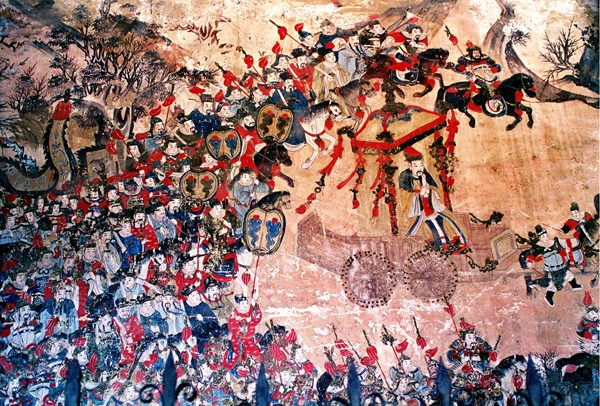
Scene of the Mount Tai God Opening and Returning the Imperial Carriage: On the north, east, and west walls inside the Tiankuang Hall are large paintings titled 'The Spirit of Mount Tai Opens and Returns to the Imperial Carriage.' The mural is over 3 meters high and 62 meters long. "Qi" means to set out, "Bi" means to clear the path and quiet the streets, also meaning to stop or pay attention, and "Hui Luan" means to return. It depicts the grand and spectacular scene of the Taishan deity making a procession. The figures in the painting are diverse and lifelike, with vivid and lifelike shapes. It is one of the unique cultural attractions of Mount Tai.
Recommended Popular

Quick Navigation
Related Recommendations